
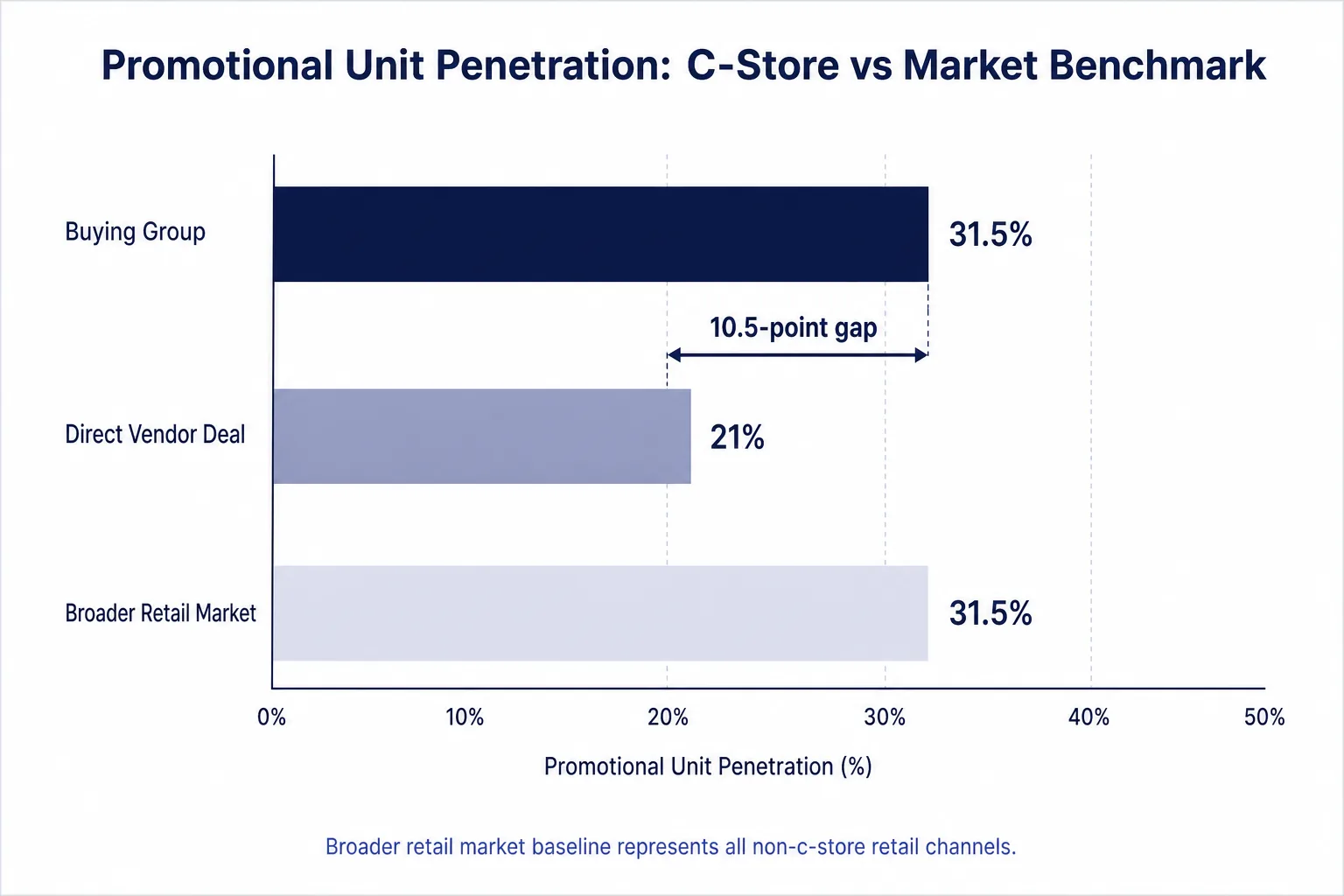
A buying group pools purchasing volume across hundreds of independent stores to unlock vendor programs and promotional funding that national chains access by default; a direct vendor deal is a one-brand negotiation that produces one rebate and no cross-category coordination. Most independent convenience store operators default to direct deals because they are familiar and immediate. The consequence is a measurable promotional gap: c-stores sell only 21% of units on promotion versus 31.5% for the broader retail market. This article breaks down an honest head-to-head comparison of both models, with specific criteria for deciding which one closes that gap for your store.
A buying group vs direct vendor deal, defined: a buying group is a coordinated network that aggregates retailer volume to qualify for national vendor programs; a direct deal is a single-store, single-brand negotiation. The buying group model is the only mechanism that delivers multi-category promotional infrastructure at chain-comparable scale.
Key Takeaways
- Count the vendors currently funding active promotions in your store; if fewer than five brands are running funded promotional activity, join a buying group before renewing any single-brand deal.
- Before signing any rebate program, ask the vendor representative whether the deal includes promotional calendar funding or only a price discount; that distinction determines your in-store execution capability.
- Evaluate vendor programs for fuel and EV infrastructure alongside in-store categories; fuel represents the majority of c-store sales volume, and EV charger network agreements are being claimed now by operators with established vendor relationships.
- When comparing buying group options, require a full participating-vendor list across all categories before committing; breadth of vendor coverage predicts whether the group can match national chain promotional depth.
Why a Single-Brand Rebate Is Not a Vendor Program
Single-brand rebates and full vendor programs are structurally different, and treating them as equivalent costs you promotional execution capability every quarter. A rebate gives you a price reduction from one supplier. A vendor program coordinates funding, promotional calendar support, and category-level sell-through tools across multiple brands simultaneously.
One recently announced independent retailer program offers up to a 5% rebate on a single manufacturer's complete product line. Cspdailynews That is a real cost savings mechanism. But 5% back on one supplier's invoices does not generate the coordinated, multi-brand promotional execution that drives foot traffic and basket size the way national chains do.
Convenience store promotion support increased 4.5% versus only 0.2% for the remaining market, yet promotional levels stayed well below the broader market: 21% of c-store units were sold on promotion compared to 31.5% for the remaining market. Convenience That 10-point gap is not a pricing problem. It is a program access problem. Single-brand rebates do not close it; coordinated vendor programs do.
The practical test: count how many vendors are actively funding promotions in your store right now. If the answer is fewer than five, a single-brand rebate is not your ceiling. It is your floor.
Buying Group vs Direct Vendor Deal: The Head-to-Head Numbers
Neither model is universally superior. The right choice depends on your store's category mix, volume, and competitive market. This table gives you the quantitative comparison where the data supports it.
|
Dimension |
Buying Group |
Direct Vendor Deal |
|---|---|---|
|
Vendor breadth |
20+ vendors across categories |
1 vendor per negotiation |
|
Rebate range |
Up to 5% per participating vendor |
Negotiated case-by-case |
|
Promotional unit penetration benchmark |
Target: 31.5% (broader market rate) |
Typical c-store average: 21% |
|
Time to first funded promotion |
30-60 days post-enrollment |
90-180 days per deal |
|
Fuel and EV vendor access |
Available through network programs |
Requires separate direct negotiations |
|
Multi-category calendar coordination |
Built into program structure |
Manual; no cross-vendor alignment |
The broader retail market runs 31.5% of units on promotion; c-stores average 21%. Convenience Closing that gap requires volume and coordination that a single direct deal cannot provide. A buying group's core function is to manufacture the volume signal that earns you the same promotional attention as a chain.
The Fuel and EV Dimension Most Operators Ignore
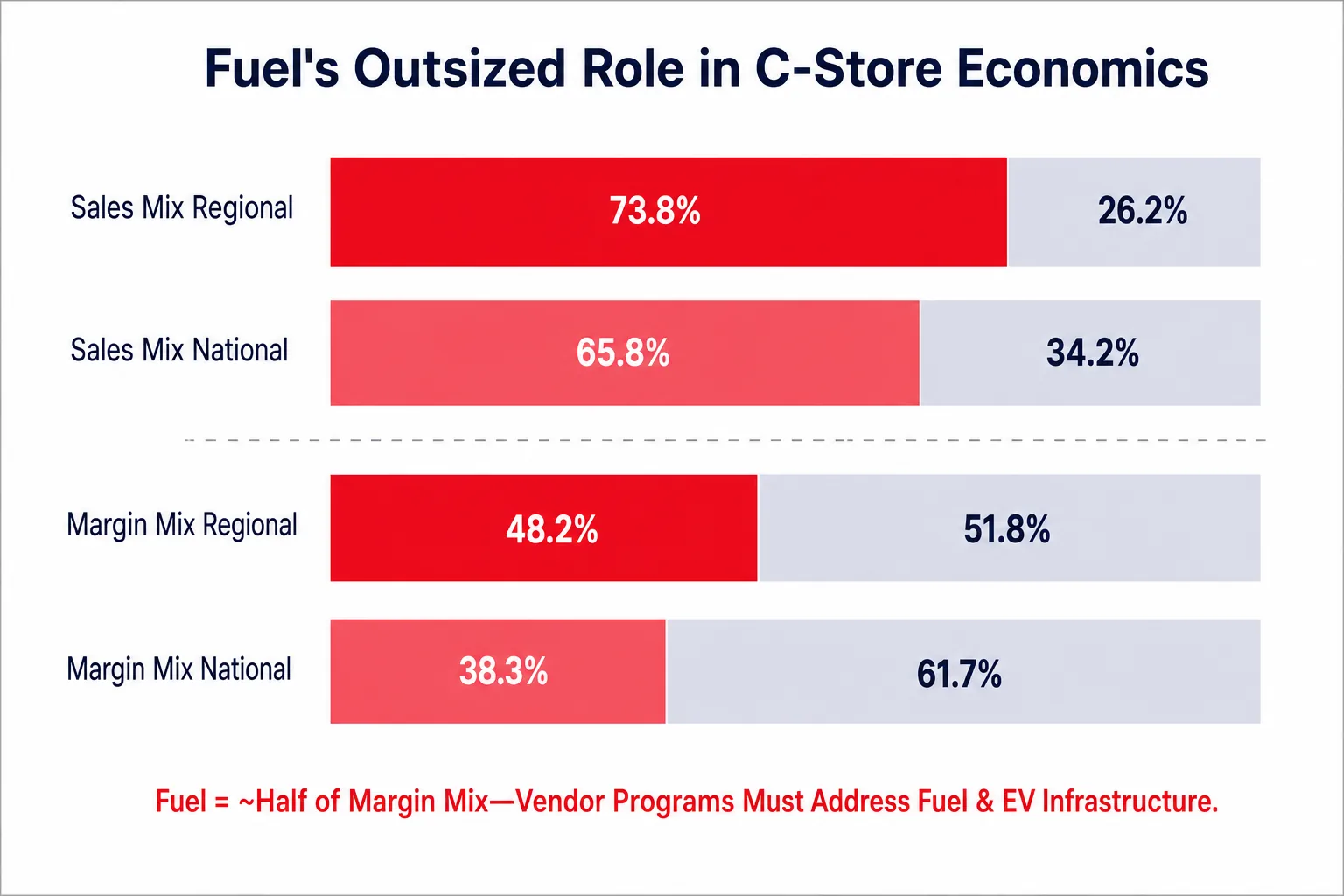
Vendor program conversations at independent c-stores almost always focus on in-store categories: beverages, snacks, tobacco. Fuel gets treated as a separate operational reality. That separation is a strategic error.
Fuel generated 73.8% of total sales mix in one regional sample versus 65.8% for the national average, and accounted for 48.2% of margin mix versus 38.3% nationally. Nacsmagazine If fuel represents nearly half of your margin mix, any vendor program evaluation that ignores fuel infrastructure relationships is evaluating less than half your business.
EV charging compounds this further. Total non-home EV charging deployment grew from 151,000 installations in mid-2023 to 204,000 by 2024, a 35% increase in roughly 18 months. Theicct Independent operators who wait until EV demand is obvious in their market will find that charger vendor programs, site agreements, and network partnerships have already been secured by chains with established vendor relationships.
Buying groups that include fuel supplier programs and EV infrastructure partnerships give you a single coordination point for your entire competitive surface. Direct deals, negotiated one brand at a time, require you to separately pursue fuel suppliers, charger networks, and in-store vendors with no shared leverage.
Where Direct Vendor Deals Still Make Sense
Direct vendor deals are not obsolete. Specific scenarios exist where going direct outperforms buying group access, and knowing the difference prevents over-indexing on either model.
Direct deals make sense when your store has genuine category dominance in a specific segment. If your location drives outsized volume in one category, a major brand's regional team will negotiate directly because your numbers justify the conversation. You can often secure terms that no buying group program would match for your specific situation.
Direct deals also make sense for exclusive local arrangements. Regional beverage distributors, local snack manufacturers, and niche suppliers rarely participate in national buying group programs. Your relationship with them is direct by necessity.
The risk of defaulting entirely to direct deals is coverage. A store running on independently negotiated vendor agreements has no safety net when a key deal expires, no cross-category promotional coordination, and no network volume to cite in a renewal negotiation. That is the position most independent c-stores occupy now. It is the primary reason the promotional penetration gap persists.
How Power Buying Dealers Connects Independents to National-Scale Programs
Power Buying Dealers was built to solve exactly the problem this article describes: independent convenience stores, gas stations, and truck stops operating without access to the vendor programs and promotional funding that national chains receive by default.
The model works by aggregating volume across a growing network of independent operators. When a vendor evaluates the Power Buying Dealers network, they see collective purchasing power at a scale that justifies national program terms, promotional funding, and category management support. Individual store owners gain access to those programs without surrendering ownership or operational independence.
The practical result: stores in the network can run multi-brand promotions across beverage, snack, tobacco, and fuel categories on a coordinated calendar, funded by vendor partners, at the same execution level a regional chain would achieve. That is the specific mechanism that closes the promotional penetration gap. It is the operational difference between 21% promotional unit penetration and the 31.5% the broader market achieves.
Conclusion
The buying group vs direct vendor deal question has a clear answer for most independent c-store operators: a buying group closes the gap with national chains faster, across more categories, and with less negotiation burden per vendor relationship. Direct deals remain valuable for category-specific volume plays and local supplier relationships, but they cannot substitute for the promotional infrastructure that national chains run by default.
The promotional penetration data makes the stakes concrete. A 10-point gap in units sold on promotion is not a pricing problem you can solve one brand at a time. It requires coordinated vendor program access at network scale.
If you want to see which vendor programs your store qualifies for across in-store, fuel, and EV categories, contact Power Buying Dealers for a direct program assessment. The conversation will identify exactly where your current vendor strategy has gaps and which programs are available to fill them.
Frequently Asked Questions
Is a single-brand rebate deal the same as joining a vendor buying program?
No. A single-brand rebate provides a price reduction from one supplier. A vendor buying program coordinates promotional funding, calendar support, and multi-category vendor access across a network of brands. The rebate is one line item. The program is an operational infrastructure. Most independent c-stores need the infrastructure, not just the discount, to compete with national chain promotional depth.
Should my convenience store join a buying group?
If your store currently runs fewer than five brands on funded promotions and your units-sold-on-promotion rate is below 25%, a buying group is the faster path to competitive parity. The key evaluation criteria are vendor breadth, category coverage across in-store and fuel, and whether the group provides promotional calendar coordination or only rebate access.
How do I know if a buying group gives me access to enough vendors to compete with national chains?
Request a full list of participating vendors before committing to any group membership. National chains run coordinated promotions across beverages, snacks, tobacco, fuel, and adjacent categories simultaneously. A buying group that covers only two or three categories leaves the majority of your competitive surface unaddressed. Breadth of vendor participation is the most reliable measure of whether the group can match chain-level promotional execution.
Should I think about vendor programs for fuel and EV, not just in-store categories?
Yes, and most independent operators have not addressed this yet. Fuel represents the majority of c-store sales volume nationally. EV charger infrastructure is now a vendor relationship category with its own program structures and network partnerships. Buying groups that coordinate across fuel suppliers and EV infrastructure vendors give independent operators consolidated leverage across their entire revenue mix, not just the in-store slice.
What promotional advantages can a buying group negotiate that a direct vendor deal cannot?
The primary advantage is not discount depth on a single product. It is access to promotional funding programs that vendors reserve for accounts meeting minimum volume thresholds. Most national beverage and snack manufacturers set those thresholds at multi-store levels that a single independent cannot reach alone. A buying group's aggregated volume clears those thresholds, unlocking funded promotions, display allowances, and coordinated marketing support that a single-store direct negotiation almost never produces.
How do I access independent retailer vendor programs without giving up operational independence?
The buying group model was designed for this. You retain full ownership and operational control of your store. The group aggregates your purchasing volume with other members to qualify for national vendor programs. You participate in the programs that fit your store's category mix and opt out of those that do not. Power Buying Dealers structures its network specifically to preserve retailer independence while providing network-scale vendor access.